Twelfth Night closes at the Orange Tree this week. We’re taking a moment to celebrate the music that makes this winter’s nearly-through-composed production so distinctive and magical.
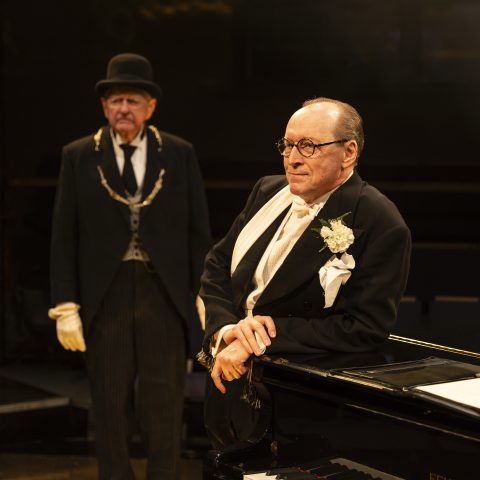
Stefan Bednarczyk wrote and arranged the score. He also plays it every night, mostly in character as Feste, the resident fool in Lady Olivia’s household.
Stefan and Anna Hampton (OT Marketing Officer) sat down to chat about his vision, source material, and the experience of scoring Shakespeare’s words, night after night after night.
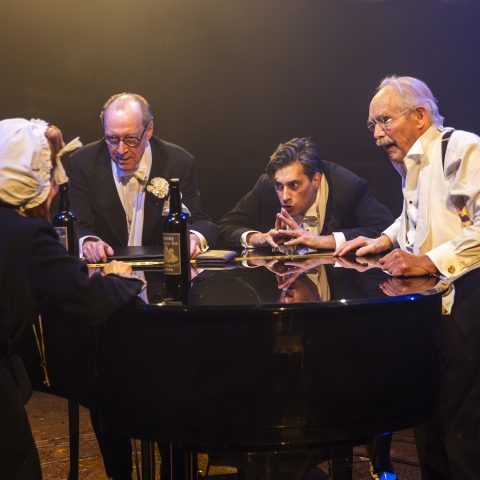
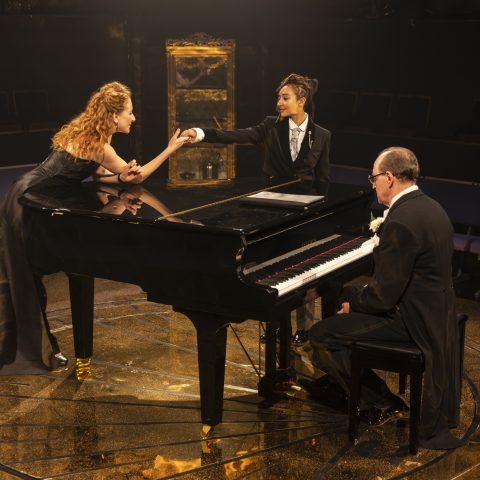
Anna Hampton (AH) – Twelfth Night opens with a reference to music: “If music be the food of love, play on.” It’s at the heart of the play, as well as this production: Tom has put it front and centre by making a baby grand piano the main set piece.
How was the show first pitched to you?
Stefan Bednarczyk (SB) – Tom and I have collaborated quite a few times, on All’s Well That Ends Well and Hamlet, and all nine plays of Noël Coward’s Tonight at 8:30 at Jermyn Street Theatre. We have an understanding of the way that the other person works, and a trust, a shorthand.
He asked me to work on Twelfth Night in June. From the beginning, he cited the essay that Virginia Woolf wrote [“Twelfth Night at the Old Vic,” published in 1942] saying that this is a play that “trembles perpetually on the brink of music.” He said, well, why not push it over the edge? About 60% of our production is accompanied by music.
AH – And, of course, it’s set in the 1940s. How did you pick music to fit the period?
SB – It was a process. I knew that it was going to be set in December 1945. Quite early on, Tom said that he thought he would probably want a tableau or funeral cortege for the opening scene, with music underneath. That was the beginning of the cooking in my brain.
An idea came to me at home. My dad was Polish, my mum was Yorkshire. The Yorkshire side of the family was steeped with amateur music, working class tradition, with a piano in the corner of the room.
And there were 78 records in our house, including one by Dame Myra Hess. During the Second World War, she organised over 1,200 lunchtime concerts at the National Gallery for troops on leave and people in reserve. It was said that Allied troops would go back to the front whistling Bach’s “Jesu, Joy of Man’s Desiring” because they’d heard it played by her.
I hit on that as the idea, partly because it was religious, so it would have resonance for a funeral or a memorial, but also it has a melt, a beautiful melancholic air.
AH – It really does. What came next?
SB – Tom and I created themes for different characters and emotions.
I started with the big romantic films of the late 1930s and 40s: lots of Korngold, Max Steiner. They’re all big, orchestral scores – too big for a production like this.
My next instinct was to think about Bach’s two-part inventions and some of the simpler Chopin, where there is a theme played in one hand and a very sparse accompaniment in the other, because a lot of a lot of the scenes are between two people. Tom said that it was lovely, but it didn’t necessarily set the period.
We then looked at popular music of the 30s and 40s, and I evolved a bank of about six different themes to improvise around, beginning with the first Broadway musical adaptation of a Shakespeare play, Rodgers and Hart’s The Boys from Syracuse, which is based on Comedy of Errors and opened in 1938. The song that I improvise on for Viola is from that show – it’s “Falling in Love with Love,” because that’s what she’s doing.
“Falling in love with love is falling for make believe. Falling in love with love is playing the fool.”
And there’s more Rodgers and Hart for Sebastian’s first entrance after meeting and falling in love with Olivia: “This can’t be love because I feel so well.”
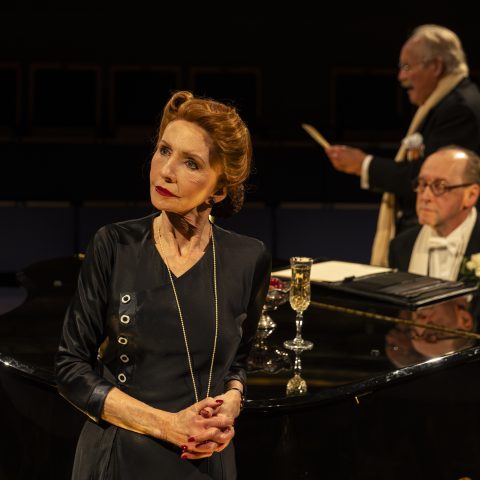
For Olivia’s theme, it was a World War Two song, “I’ll Be Seeing You,” because she’s mourning both father and brother. The words of it are, “I’ll be seeing you in all those old familiar places that this heart of mine embraces, all day through, in the small hotel the wishing well.” Everywhere she looks, she sees one of them.
We used those tunes, but in the way that a Bach two-part invention might employ them. There’s just one note at a time in the left hand and the tune is played in different speeds or different formations in the right hand, depending on what’s going on in the dialogue.
And of course, there are some songs from the period that we use in the production. Noël Coward wrote “Sigh No More” for his review that opened as the Second World War ended. I begin the second act with that song, and it’s exactly contemporaneous with where and when we set the play. The title is Shakespeare’s, as well.
AH – Having so meticulously planned the musical world of the play, how did you actually build Feste’s character?
SB – Well, there was a wonderful cabaret performer called Leslie Hutchison, who had very lowly origins in the West Indies, but became a high society performer in London and New York. He had an affair with Cole Porter, he had an affair, allegedly, with Princess Margaret. But his life was precarious. It was like the minstrels of old. When he fell out of favour or fashion, then he fell quite low.
AH – And that’s Feste.
You sit at the piano for most of Twelfth Night’s runtime, and sometimes you’re an active participant in the scene, sometimes you’re mostly underscoring it. How do you navigate the relationship between your roles as character and pianist?
SB – The relationship is deliberately fluid. Tom and I were very keen not to pin it down. At one point, there was an idea that when I was Feste, I would have a top hat, and when I was the pianist, I’d take it off. But it just seemed a rather clumsy way of doing it. We couldn’t figure out where to keep the top hat.
AH – Do you improvise when you’re playing through the show?
SB – The music is probably about ten percent improvisation every night. I have a sort of cheat sheet which will say “upper half of keyboard” or “lower” or “full” or “sparse.” And there are times when the dialogue changes speed, so I play more quickly or slowly.
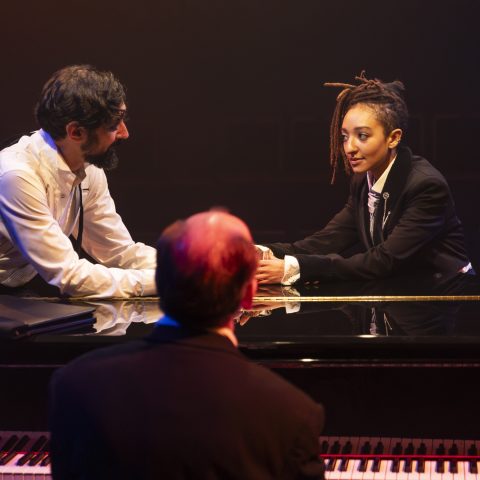
AH – I’d love to listen, now, to some of your original music. “Come Away Death” is a song written into Shakespeare’s script. It’s part of a beautiful scene that finds Viola and Orsino debating the nature of love. In our production they put their heads down on the belly of the piano and listen as you play.
SB – I wrote “Come Away Death” in an old style. If you listen to what Orsino says about the song in the scene, it is for him a thing of the old times, the gold times, which for him, would be the first World War.
So that I wrote inspired by the songs and music I remember being on my grandma’s piano stand: songs like “Love’s Old Sweet Song,” “Bless This House,” a bit of operetta, some parlour songs, Moody and Sankey revivalist hymns, things like “The Old Rugged Cross.”
AH – In terms of character themes, I particularly love Sebastian and Viola’s, based on “This Can’t Be Love” —
SB – And going into “Falling in Love with Love.”
That’s played quite a bit throughout the play. When they reunite, it is two parts with an absolutely rigid tempo. It’s the inevitability of them coming together.
AH – My experience of it as an audience member was that it really emotionally centred the play around their relationship as twins.
SB – That’s right.
AH – And you’ve written lots of other underscoring that’s incredibly fun. Viola and Aguecheek’s duel, for instance, is very dramatic.
There are also clock sounds –
SB – There’s sort of an Edwardian parlour clock that we hear whenever Sir Toby enters that has one missed chime.
And in the second half, when Cesario rejects Olivia, there’s a very delicate, tiny clock. It sort of chills the heart, and the next line is “the clock upbraids me with the waste of time.”
AH – That’s a beautiful moment, and of course time is such an important theme in this play, and your music gives it structure.
What are you most looking forward to in these last weeks of performances?
SB – I’m sat there listening every night, hearing actors just gently, like jazz, riff on Shakespeare’s verses. I look forward to listening to those imperceptible changes in the play, that ten percent improvisation.
I hope that audiences continue to enjoy it as much as the ones thus far have. It is, I think, a wonderful production that Tom has put together. And I absolutely adore my fellow cast members, without exception, and love what they’re doing. I would like my back to hurt a little less.
AH – The curse of the piano bench!
SB – I will be very sad when it ends. But perhaps it’s good that it ends at a particular point – it adds value and piquancy to these final weeks.
TWELFTH NIGHT recordings and sound design by Matt Eaton.
Production photos by Ellie Kurttz.